Calculation Results
Scalar Multiplication of Matrices
This article explains scalar multiplication for matrices, provides formulas, worked examples, common pitfalls, and practice problems with hidden answers. Designed as companion content for a Matrix Scalar Multiplication Calculator.
Definition and Formula
Scalar multiplication is the operation of multiplying every entry of a matrix by a scalar (a real or complex number). If $k$ is a scalar and $A$ is an $m\times n$ matrix with entries $a_{ij}$, then the scalar multiple $kA$ is the $m\times n$ matrix whose $(i,j)$ entry is $k a_{ij}$.
Formally, if
$$ A = [a_{ij}]_{m\times n} = \begin{pmatrix} a_{11} & a_{12} & \cdots & a_{1n} \\ a_{21} & a_{22} & \cdots & a_{2n} \\ \vdots & \vdots & \ddots & \vdots \\ a_{m1} & a_{m2} & \cdots & a_{mn} \end{pmatrix}, $$then
$$ kA = [k a_{ij}]_{m\times n} = \begin{pmatrix} k a_{11} & k a_{12} & \cdots & k a_{1n} \\ k a_{21} & k a_{22} & \cdots & k a_{2n} \\ \vdots & \vdots & \ddots & \vdots \\ k a_{m1} & k a_{m2} & \cdots & k a_{mn} \end{pmatrix}. $$Properties (useful for calculator UX & SEO)
- Distributive over matrix addition: $k(A + B) = kA + kB$.
- Associative with scalar multiplication: $(kl)A = k(lA)$ for scalars $k,l$.
- Multiplying by 1 leaves the matrix unchanged: $1 \cdot A = A$.
- Multiplying by 0 yields the zero matrix: $0 \cdot A = 0_{m\times n}$.
Worked Example 1 (2×2)
Compute $3A$ for
$$ A=\begin{pmatrix} 1 & -2 \\ 4 & 0 \end{pmatrix}. $$Solution:
$$ 3A = 3 \begin{pmatrix} 1 & -2 \\ 4 & 0 \end{pmatrix} = \begin{pmatrix} 3\cdot 1 & 3\cdot(-2) \\ 3\cdot 4 & 3\cdot 0 \end{pmatrix} = \begin{pmatrix} 3 & -6 \\ 12 & 0 \end{pmatrix}. $$Worked Example 2 (3×3, scalar zero and negative)
Compute $-2B$ for
$$ B=\begin{pmatrix} 0 & 1 & 2 \\ -1 & 3 & 0 \\ 4 & -2 & 5 \end{pmatrix}. $$Solution:
$$ -2B = -2\begin{pmatrix} 0 & 1 & 2 \\ -1 & 3 & 0 \\ 4 & -2 & 5 \end{pmatrix} = \begin{pmatrix} 0 & -2 & -4 \\ 2 & -6 & 0 \\ -8 & 4 & -10 \end{pmatrix}. $$Common Mistakes and Tips
| Common mistake | Tip / correct approach |
|---|---|
| Treating scalar multiplication like matrix multiplication | Scalar multiplies each entry independently; there is no dimension constraint. |
| Forgetting to multiply negative signs | Distribute scalar sign to each entry carefully (e.g., $-2\cdot(-3)=6$). |
| Attempting to multiply scalar only to a row or column | Clarify whether intended operation is scalar multiplication (whole matrix) or scaling a specific row/column. |
| Confusing 0 scalar with zero matrix | $0\cdot A$ yields the zero matrix of same size; $0_{m\times n}$ is not the scalar 0. |
Practice Problems (compute and show final result)
Each exercise asks for the scalar multiple. Answers are hidden; click "Show Answer" to reveal.
Exercise 1 — Multiply by a positive integer:
$$A = \begin{pmatrix} 2 & -1 \\ 5 & 3 \end{pmatrix}, \quad \text{compute } 4A.$$Show Answer
Compute each entry: multiply by 4
$$ 4A = \begin{pmatrix} 8 & -4 \\ 20 & 12 \end{pmatrix}. $$Exercise 2 — Multiply by zero:
$$B = \begin{pmatrix} 1 & 2 & 3 \\ -1 & 0 & 4 \end{pmatrix}, \quad \text{compute } 0\cdot B.$$Show Answer
Every entry becomes zero (same size as B):
$$ 0\cdot B = \begin{pmatrix} 0 & 0 & 0 \\ 0 & 0 & 0 \end{pmatrix}. $$Exercise 3 — Multiply by a negative scalar:
$$C = \begin{pmatrix} 0 & -3 \\ 2 & 1 \\ -4 & 5 \end{pmatrix}, \quad \text{compute } -3C.$$Show Answer
Multiply each entry by -3:
$$ -3C = \begin{pmatrix} 0 & 9 \\ -6 & -3 \\ 12 & -15 \end{pmatrix}. $$Exercise 4 — Fractional scalar:
$$D = \begin{pmatrix} 6 & 2 & -3 \\ 0 & 4 & 8 \\ 1 & -1 & 5 \end{pmatrix}, \quad \text{compute } \tfrac{1}{2}D.$$Show Answer
Multiply each entry by 1/2 (divide entries by 2):
$$ \tfrac{1}{2}D = \begin{pmatrix} 3 & 1 & -\tfrac{3}{2} \\ 0 & 2 & 4 \\ \tfrac{1}{2} & -\tfrac{1}{2} & \tfrac{5}{2} \end{pmatrix}. $$Scalar multiplication also leads naturally to eigenvalues, RREF, and matrix powers.
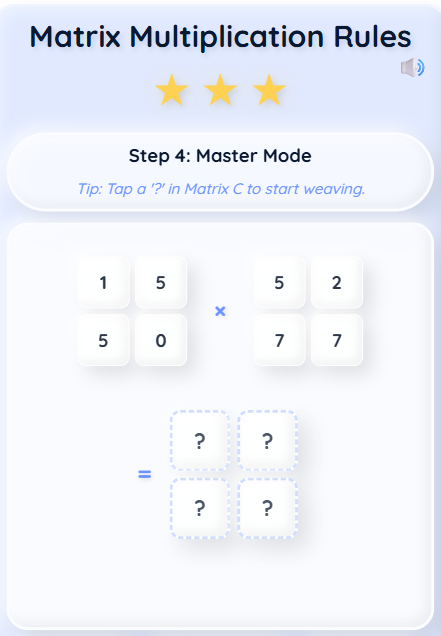
Learn matrix multiplication more easily in just 2 minutes with this free game.