Calculation Results
1. Definition & formula
Cholesky decomposition factors a real, symmetric, positive-definite matrix \(A\) as
where \(L\) is a lower-triangular matrix with positive diagonal entries and \(L^{T}\) is its transpose.
Cholesky is applicable only when \(A\) is symmetric (\(A=A^{T}\)) and positive-definite.
2. How to compute Cholesky (component formulas)
For a 3×3 symmetric matrix
Compute \(L\) by:
- \(l_{11} = \sqrt{a_{11}}\).
- \(l_{21} = \dfrac{a_{12}}{l_{11}},\; l_{31} = \dfrac{a_{13}}{l_{11}}\).
- \(l_{22} = \sqrt{a_{22} - l_{21}^2}\).
- \(l_{32} = \dfrac{a_{23} - l_{21}l_{31}}{l_{22}}\).
- \(l_{33} = \sqrt{a_{33} - l_{31}^2 - l_{32}^2}\).
General algorithm: process rows/columns sequentially computing diagonal terms via square roots and off-diagonal terms by division using previously computed entries.
3. Worked examples
Example 1 (2×2)
Step 1: \(l_{11}=\sqrt{4}=2\).
Step 2: \(l_{21}=a_{12}/l_{11}=2/2=1\).
Step 3: \(l_{22}=\sqrt{3-1^2}=\sqrt{2}\).
Result:
Example 2 (3×3)
\(l_{11}=\sqrt{9}=3\).
\(l_{21}=3/3=1,\; l_{31}=6/3=2\).
\(l_{22}=\sqrt{5-1^2}=\sqrt{4}=2\).
\(l_{32}=(3-1\cdot2)/2=1/2\).
\(l_{33}=\sqrt{14-2^2-(1/2)^2}=\sqrt{9.75}\).
Result:
4. Common mistakes & pitfalls
- Applying Cholesky to matrices that are not symmetric or not positive-definite: decomposition will fail (square roots of negative numbers appear).
- Forgetting symmetry check: always verify \(A = A^{T}\) before attempting Cholesky.
- Numerical stability: small rounding errors can make a near-positive-definite matrix appear non-positive-definite; consider adding a tiny regularization (e.g. diagonal shift) in numeric code.
- Sign mistakes inside square roots: ensure correct subtraction of squared terms from the diagonal entry.
- Confusing with LU factorization: Cholesky is a special-case \(A=LL^{T}\) valid only for symmetric positive-definite matrices.
5. Practice problems (answers hidden)
Click Show Answer to reveal the Cholesky factor \(L\).
Exercise 1
Show Answer
Exercise 2
Show Answer
Exercise 3
Show Answer
(These entries can be rationalized or left as radicals; numeric approximations are acceptable for calculators.)
Exercise 4
Show Answer
Cholesky decomposition is related to eigenvalues, matrix multiplication, and matrix rank.
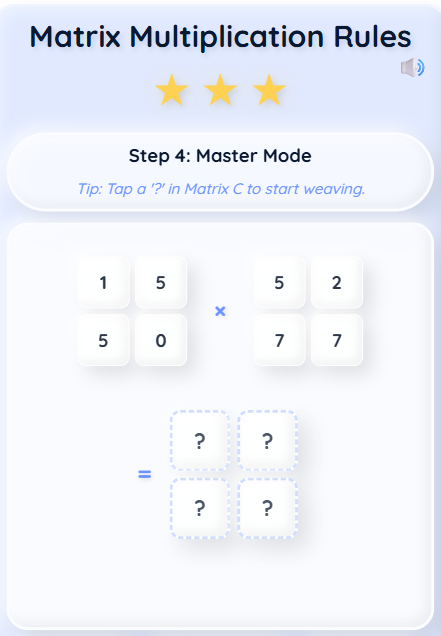
Learn matrix multiplication more easily in just 2 minutes with this free game.